
Why These 2 Essential Financials Can Help Win Your Commercial Property Tax Protest
About the Author: Nicole Schnell


Here’s what you need to know about winning a commercial property tax protest in Texas:
- The rent roll and the P&L are the two most important financials needed for a successful and significant protest.
- The rent roll provides an accurate, fixed picture of income on January 1st, while the P&L provides actual operating income and expenses with a defensible NOI.
- There are at least four leverage points we’ve identified in our experience where actual financials can beat out the CAD’s pro forma assumptions: expense ratio, vacancy and collection loss, rent roll, and cap rate.
- Work with Gill, Denson & Company to leverage our customized strategy and increase the likelihood of a successful reduction in value.
The Most Important Financials in a Commercial Property Tax Protest
The income approach is typically the most reliable indicator of market value for income-producing properties (multifamily, office, retail, industrial, hotels, RV parks). It’s also the approach that county appraisal districts (CADs) and ARBs give the most weight to in commercial protests. The Profit & Loss (P&L) and rent roll financials are raw inputs that drive the income calculation in this method. Without them, you’re stuck arguing comparable sales or cost approach, which CADs routinely dismiss for stabilized commercial assets.
Texas Tax Code §23.012 states that the chief appraiser shall consider the income method when appraising income-producing property if there is sufficient data. Providing actual property financials pushes the CAD to use the appraisal method where you have the strongest protest case.
What Each Document Tells You
The January rent roll gives you a snapshot of income as of the January 1st assessment date. This includes current tenants, lease start/end dates, contract rents, square footage occupied, vacant units, concessions, and any below-market or above-market leases. It establishes the actual occupancy and effective rent per square foot and per unit, which are the starting points for any income reconstruction.
A Profit & Loss statement gives you actual operating expenses. It typically shows the trailing 12 months of taxes, insurance, utilities, repairs, maintenance, management fees, payroll, marketing, and CapEx (capital expenditures) versus OpEx (operating expenses) items. This lets you build a defensible NOI rather than relying on the CAD’s pro forma assumptions. Their assumptions are almost always built from county-wide averages that don’t reflect the individual property’s reality.
The Income Approach Mechanics
It’s important to understand how the income approach is used to ensure your financial data truly backs up your argument for a lower appraisal.
The standard direct capitalization formula begins by determining the effective gross income (EGI). You do this by subtracting Vacancy & Collection Loss from the Potential Gross Income (PGI), which is the rent roll at market or contract value. Then, subtract the OpEx (taken from P&L, normalized) from the EGI to get the Net Operating Income (NOI). Now, divide the NOI by the cap rate to find the Indicated Market Value.
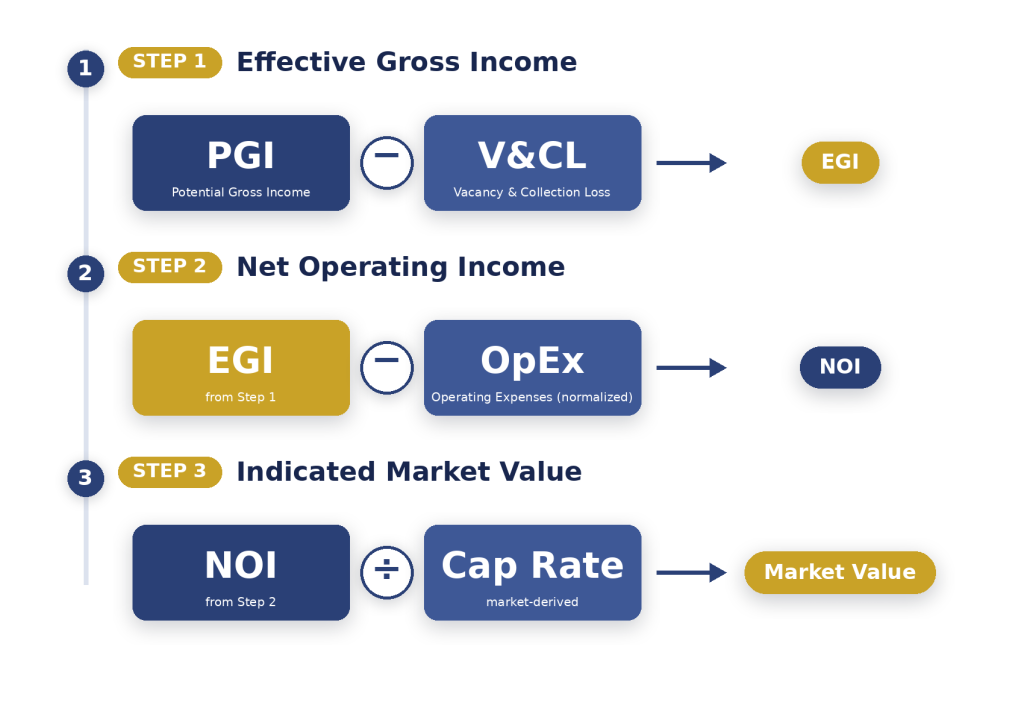
The cap rate is the return an investor would require to buy the property. This is derived from comparable sales, broker surveys (such as CBRE, JLL, RealtyRates, Korpacz/PwC), or band-of-investment analysis. A higher cap rate is equivalent to a lower value. So, a property with $500,000 NOI at a 7% cap rate is worth around $7.14M. However, at 8.5%, it’s worth about $5.88M.
The cap rate selection is often where a commercial property tax protest is either won or lost. This is why it’s essential to have in-depth knowledge of the mechanics of the income approach. One wrong calculation can mean a difference of millions in valuation, which then means a higher property tax bill.
How You Can Use This to Win
There are some leverage points where your actual financials can beat the CAD’s pro forma. These are:
- Expense Ratio: Your real expense ratio is almost always higher than the CAD’s modeled ratio. This is especially true with older Class B/C assets, properties with deferred maintenance, or anything with elevated insurance costs (a huge issue in Texas post-2023). Showing actuals at, say, a 48% expense ratio when the CAD modeled 35% can drop your NOI substantially.
- Vacancy and Collection Loss: Your actual vacancy and collection loss also often exceed the CAD’s assumed 5-7%. It’s much easier to prove when bad debt, concessions, and downtime between tenants are documentable from the P&L.
- Rent Roll: In-place rents from the rent roll may be below market, but for the tax year in question, that’s the income the property actually produced. If the CAD uses market rents on a property locked into long-term, below-market leases, then the rent roll is strong evidence of a lower appraisal value.
- Cap Rate Arbitrage: CADs tend to use aggressive (meaning low) cap rates that inflate value. Pulling published investor surveys for the property type and class, plus any local comparable sales with derivable cap rates, lets you argue for a higher rate. Even 50 basis points of movement on a sizable property is often a six-figure reduction in value.
The Tax Code §41.43 also lets you argue equity (uniform and equal) alongside market value. However, for income property, the income approach usually makes a larger difference at the ARB hearing or in arbitration. Especially when the appraiser on the other side is working from the CAD’s pro forma rather than the actual financials.
A Practical Protest Workflow
Our team of property tax experts has years of experience and in-depth knowledge of income-producing properties and their valuations. We’ve developed a streamlined, practical workflow that we tailor to each client’s needs. First, we take the rent roll and trailing 12 months P&L, and:
- Normalize the expenses (strip out non-recurring items, owner-specific costs, non-operating expenses, and CapEx that should be reserved rather than expensed)
- Build the reconstructed NOI
- Apply a defensible cap rate sourced from current market data
- Present the indicated value alongside the CAD’s noticed value
The delta (the difference) then becomes your ask in the protest. At an informal hearing, this is often enough to settle the case. In front of the ARB, we walk the panel through each line item and force the district appraiser to defend deviations from documented actuals. They typically can’t do this convincingly when their analysis is built on county averages.
The whole strategy hinges on having those two documents: the rent roll and P&L. Without them, you’re arguing in the abstract and may not see a significant change, if any at all. With them, you’re arguing arithmetic and can potentially save thousands, if not hundreds of thousands.
Do you own an income-producing commercial property? Get started with Gill, Denson & Company today for a customized approach to lower your commercial property tax liability. In 2025, we helped over 80% of our commercial clients receive a reduction in their commercial property taxes.